
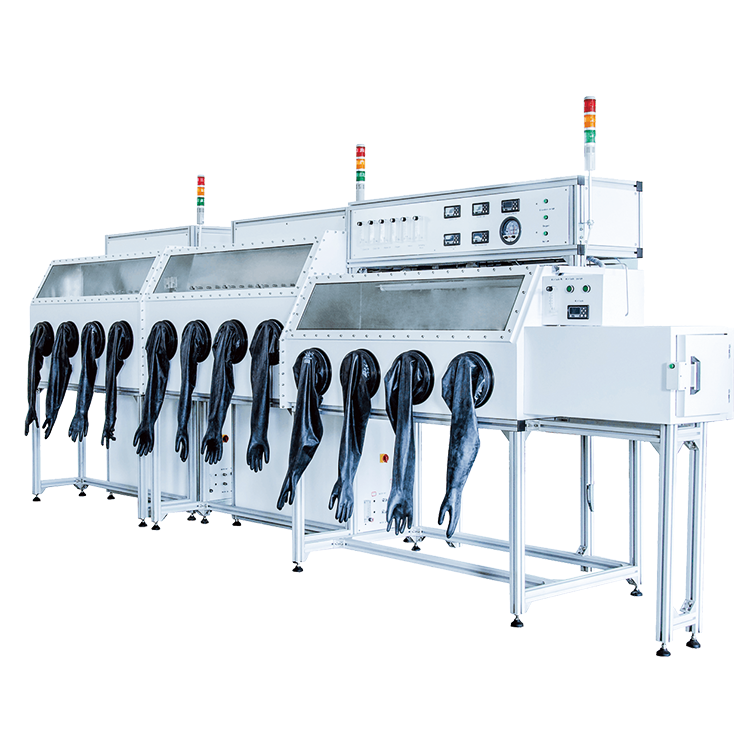
In laboratory R&D and small-batch thin-film fabrication, vacuum glove boxes and vacuum coating machines often operate as independent standalone devices. Manual operation and separate control workflows are sufficient to support sample testing, process verification, and low-volume production. However, for large-scale industrial vacuum coating lines — including optical coating, semiconductor thin-film deposition, and precision electronic component coating — relying on disconnected standalone equipment severely restricts line automation, production stability, and overall equipment effectiveness (OEE).
Modern industrial thin-film manufacturing is rapidly evolving toward full-process automation, unmanned continuous operation, and smart factory digital management. For large turnkey production projects, equipment performance is no longer evaluated by individual static parameters alone. Instead, cross-device compatibility, synchronous linkage capability, and safety interlock reliability have become the core benchmarks for distinguishing laboratory-grade equipment from industrial-grade integrated solutions. For process engineers, system integrators, and procurement decision-makers, optimizing glove box and vacuum coater communication and control integration is the key to eliminating hidden production bottlenecks and maximizing long-term manufacturing profitability.
This article systematically analyzes the limitations of standalone vacuum equipment in automated production scenarios, elaborates on industrial communication protocols, synchronous automation logic, and safety interlock mechanisms for glove box-coater linkage, and provides practical procurement and technical selection standards for large-scale vacuum coating production line integration projects.
The Hidden Bottlenecks of Standalone Glove Boxes in Automated Coating Lines
Most standard vacuum glove boxes are designed for independent laboratory operation, equipped with closed local control systems that only support manual parameter adjustment, independent pumping and purging cycles, and standalone atmosphere stabilization. These devices can fully meet basic quality requirements such as ultra-low O₂/H₂O concentration and low leak rate but lack industrial-level data interaction and synchronous linkage functions required for automated production lines.
When deployed in large continuous vacuum coating production systems, standalone equipment architecture triggers three major industrial pain points that restrict line capacity and batch stability.
First, inconsistent production tact time caused by manual intervention. Without automatic linkage control, operators need to manually trigger glove box evacuation, gas purging, and substrate transfer according to coating progress. Manual operation errors and inconsistent rhythms break the continuous cycle of automated vacuum coaters, resulting in frequent equipment idle time and reduced overall line production efficiency.
Second, isolated equipment data leads to missing process traceability. Standalone glove boxes cannot synchronize operating data, atmosphere parameters, and equipment status with vacuum coating hosts and factory MES systems. Independent data formation creates serious data silos, making full-batch quality traceability and data-driven process optimization impossible for industrial production.
Third, asynchronous equipment logic brings potential process and safety risks. Mismatched opening and closing timing between the glove box antechamber and vacuum coater chamber easily causes atmosphere turbulence, vacuum pressure impact, and cross-contamination between process environments. These abnormal conditions directly lead to thin-film unevenness, poor substrate adhesion, and inconsistent batch yield, bringing irreversible quality losses to large-scale automated production.
Industrial Communication Protocol Compatibility: The Foundation of Full-Line Interconnection
Real-time data interconnection between glove boxes and vacuum coating equipment is the primary prerequisite for realizing full-line automation integration. Static indicators such as gas purity and leak rate only ensure product qualification, while standardized industrial communication compatibility determines the upper limit of equipment automation and intelligent expansion capability.
Industrial-grade integrated vacuum glove boxes are fully optimized for automated production line docking, supporting all mainstream open industrial communication protocols, including Modbus RTU/TCP, PROFIBUS, and TCP/IP industrial Ethernet. Equipped with complete multi-channel IO signal interfaces and reserved industrial Ethernet ports, these glove boxes achieve stable two-way real-time data interaction with vacuum coating hosts, PLC central control systems, and factory MES manufacturing execution systems.
Through standardized protocol docking, the glove box actively uploads core operational data — including real-time vacuum pressure, internal oxygen and moisture concentration, purification system operating status, chamber door switch state, and fault alarm information — to the central control platform and coating equipment. Meanwhile, it automatically receives production scheduling and process linkage instructions from the host system, realizing unified data synchronization, real-time equipment status monitoring, and centralized full-line production management.
For large smart factory projects requiring long-term upgradability, customized OPC UA protocol integration is available. As the mainstream industrial Internet communication standard, OPC UA enables seamless connection between vacuum equipment and industrial cloud platforms, reserving sufficient expansion space for subsequent intelligent factory upgrading, remote equipment management, and big data process optimization.
Synchronous Automation Logic & Dual Safety Interlock: Core Advantages of Industrial-Grade Integration
Genuine full-line automation integration is not limited to simple signal connection. The core value of industrial vacuum glove box-coater linkage lies in process-level synchronous closed-loop control and dual-layer safety interlock protection, which fundamentally solves the instability problems of traditional manual and semi-automatic production modes.
Production Beat Synchronization: Closed-Loop Matching of Transfer and Coating Cycles
Automated linkage systems build a highly coordinated closed-loop production logic between glove box substrate handling and vacuum coating processes. According to the fixed production tact time of the vacuum coater, the industrial glove box automatically completes pre-evacuation, multi-cycle inert gas purging, and ultra-clean atmosphere stabilization to reach standby status in advance.
After the coating host completes a single-cycle thin-film deposition process, the system automatically triggers precise antechamber docking and unmanned substrate loading and unloading. The entire material transfer and atmosphere replacement process fully matches the coating cycle rhythm without any manual intervention.
This automated closed-loop control eliminates human-induced tact time deviations, ensures consistent batch-to-batch production cycles, maximizes the running efficiency of high-value vacuum coating equipment, and effectively improves the overall production capacity and long-term yield stability of thin-film manufacturing lines.
Dual Safety Interlock Mechanism: Zero-Risk Isolation for Automated Production
Vacuum coating processes have extremely strict requirements for vacuum sealing and inert atmosphere isolation. Asynchronous equipment actions in automated lines are likely to cause process pollution and equipment failure. Industrial-grade linkage systems adopt a hardware + software dual safety interlock architecture to build a comprehensive production safety barrier.
The system sets exclusive interlock protection logic for key production links: the vacuum coater chamber remains locked if the glove box antechamber is not in place or fails vacuum and atmosphere qualification; the antechamber atmospheric door is strictly prohibited from opening during the high-vacuum working state of the coating host. Once abnormal fluctuations in O₂/H₂O concentration, vacuum failure, or equipment faults are detected in the glove box, the linkage system will immediately trigger the coating equipment to pause operation, effectively preventing mass defective batches caused by atmospheric abnormalities.
Engineering & Procurement Selection Standards for Large Vacuum Coating Projects
For large turnkey vacuum coating projects and intelligent production line upgrades, engineering and procurement teams need to change traditional equipment selection logic. Beyond focusing on basic quality parameters such as leak rate and gas purification accuracy, priority should be given to industrial integration capabilities that determine long-term line operation efficiency.
First, prioritize multi-protocol compatible industrial control systems. Select glove box equipment with complete native industrial communication interfaces to support plug-and-play docking with mainstream vacuum coaters and factory central control systems, avoiding additional secondary transformation costs and compatibility risks in the later stage of project delivery.
Second, adopt process-customized linkage control logic. Optical coating, semiconductor deposition, and functional film coating processes have different production cycles and safety threshold standards. Professional industrial glove box suppliers can customize exclusive synchronous control programs and interlock parameters according to project process characteristics, ensuring full fit with actual production needs.
Third, reserve intelligent digital management functions. Industrial integrated glove boxes support cloud data upload, remote real-time monitoring, and equipment fault early warning. These functions seamlessly connect with MES and SCADA systems to realize automated production data statistics, remote operation and maintenance management, and equipment predictive maintenance, adapting to the operation mode of modern smart factories.
Conclusion: System Integration Defines High-End Industrial Vacuum Manufacturing
In the homogenized vacuum equipment market, basic atmosphere control and sealing performance have become industry standard configurations. The core technical competitiveness of high-end industrial vacuum glove boxes lies in full-line integration capability and intelligent automation control level.
For large-scale industrial vacuum coating production lines, standalone equipment can only meet low-efficiency basic production needs, while integrated linkage solutions can optimize production tact time, stabilize batch yield, reduce manual operation risks, and realize full-process data traceability and intelligent management. It is the most cost-effective technical upgrade path for medium and large thin-film manufacturing enterprises to improve line efficiency and comprehensive profitability.
We provide industrial-grade vacuum glove box full-line integration solutions, covering multi-protocol communication docking, customized linkage interlock logic programming, and turnkey automation system deployment. We help global semiconductor and optical thin-film manufacturers realize unmanned, efficient, and intelligent upgrading of vacuum coating production lines.
#VacuumGloveBox #VacuumCoating #FullLineIntegration #IndustrialAutomation #ProcessControl #SmartFactory #SemiconductorManufacturing #OpticalCoating #PLCSystem #MESIntegration #VacuumProcessAutomation